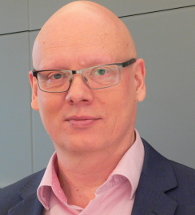
PERSONAL INFORMATION
Ilkka Tuomi
ilkka.tuomi (at) nospam
meaningprocessing.com 
Layout looks strange?? Yes, no responsive design. I have been coding this by hand for some two decades now...
A
couple of papers and presentations, and some other stuff...
(An archive for Finnish readers.
These were published in Tekniikka & Talous.)
1991-1994
Organisaation sähköjäniksenä
Luultavasti ette tule kohtaamaan mademoiselle
Gosselinia. Hän on kuollut ja hänen nimensä on kadonnut
tietosanakirjoista ja sivistyneistön muistista. Hän oli ensimmäinen
ihmi...
Tieto vähentää tuskaa
Tänään kannatan EY-jäsenyyttä. Meille on
kerrottu, että suomalaiset ovat aina pärjänneet parhaiten vaikeina
aikoina. Niitä on odotettavissa, kun Suomi liittyy EY:hyn....
more stories 1991-94...
1995-1999
Uusi lukujärjestys
Mikäli koululaisille ja opiskelijoille
laskettaisiin työajalta palkkaa, Suomen bruttokansantuote kasvaisi
noin 300 000 työläisen vuosityöpalkalla. Hyvinkoulutettu kansalainen
...
Kyberherätys!
Helvetin kattila on paikka, jonne lukemattomat
suomalaiset ovat vuosien saatossa joutuneet. Tie käy uskon kautta.
"Tahdon olla huono ja mitätön omissa silmissäni, sanokoot siit...
more stories 1995-99...
2000-2004
Internetin pitkä aalto
Maailmanhistorian suurista kaarista on
kirjoitettu monta ihmeellistä tarinaa, mutta vain muutama klassikko.
Yksi, ja ajankohtainen, on Carlota Perezin puolitoista vuosikymmentä
s...
Piilaakson tarinoita
“Muutama päivä sitten olin menossa tapaamaan
ystävääni sairaalaan. Samaan hissiin tuli joku, ja tuli puheeksi, että
olen käynnistämässä firmaa internet-musiikin jakeluu...
more stories 2000-04...
2005-2006
Korean kotirobotti
Euroopan komiteat ovat joskus vähän jähmeitä.
Niiden visiot kääntyvät ajassa taaksepäin, katsomaan menneitä
kulta-aikoja. Tulevaisuuden toivekuvat hahmottuvat vanhojen men...
Tuottavuuden lasku
Tietoyhteiskunnassa tuottavuus laskee.
Tietoyhteiskunnassa yhä useammat ihmiset tekevät luovaa työtä ja
palveluja. Niiden tuottavuus mitataan nykyisin työn tekemiseen
käytett...
more stories 2005-6...
Sorry about being too busy lately. I simply cut and paste some recent lines from my CV here:
- Tuomi, I. (2020) The use of Artificial Intelligence (AI) in education. Background report for the European Parliament. The report has been published on the European Parliament Think Thank blog in September 2020.
- Tuomi, I. (2019) Chronotopes of foresight: Models of time-space in probabilistic, possibilistic and constructivist futures. Futures & Foresight Science. 2019;e11. doi:10.1002/ffo2.11
- Craglia M., Annoni A., Benczur P., Bertoldi P., Delipetrev P., De Prato G., Feijoo C., Fernandez Macias E., Gomez E., Iglesias M., Junklewitz H, López Cobo M., Martens B., Nascimento S., Nativi S., Polvora A., Sanchez I., Tolan S., Tuomi I., Vesnic Alujevic L. (2018) Artificial Intelligence - A European Perspective, EUR 29425 EN, Publications Office of the European Union, Luxembourg, 2018, doi:10.2760/11251.
- Tuomi, I. (2018) The impact of artificial intelligence on learning, teaching and education: Policies for the future. Publications Office of the European Union, Luxembourg, November 2018.doi:10.2760/12297
- Tuomi, I. (2018) "AI and the future of foresight.: On the impact of neural networks on probabilistic, possibilistic, and constructivist foresight." FTA 2018, Brussels, 4-5 June 2018.
- Tuomi, I. (2018) "Dialogical ethics in AI: Towards an adequate theory of agency in the age of machine learning." FTA 2018, Brussels, 4-5 June 2018.
- Tuomi, I. (2018). "Vygotsky Meets Backgpropagation: Artificial Neural Models and the Development of Higher Forms of Thought." In Artificial Intelligence in Education: 19th International Conference, AIED 2018, London, UK, June 27-30, 2018, Part I, edited by Carolyn Penstein Rose, et al. Lecture Notes in Artificial Intelligence. Springer International Publishing. doi:10.1007/978-3-319-93843-1_42.
- Ehresmann, André, Ilkka Tuomi, Riel Miller, Mathias Béjean, and Paul Vanbremeersch. (2018) Towards a Formal Framework for Describing Collective Intelligence Knowledge Creation Processes That "Use-the-Future". In: Miller, R. (ed.) Transforming the Future: Anticipation in the 21st Century, pp. 66-91. London: Routledge.
- Tuomi, I. (2017). "Ontological Expansion." In: Poli, R. (ed.) Handbook of Anticipation, 1-35. Cham: Springer International Publishing. doi:10.1007/978-3-319-31737-3_4-1.
- Tuomi, I. (2017). "Robert Rosenin ennakoivat systeemit ja tieteiden seuraava vallankumous." Futura 36 (3): 93-102.
- Tuomi, I. (2015) Epistemic literacy or a clash of clans? A capability-based view on the future of learning and education. European Journal of Education, 50 (1), pp. 21-4. doi: 10.1111/ejed.12101
...and some recent invited talks:
- Digital Skills @ICT2018: Plenary with Commissioner Gabriel; ICT 2018, Vienna, 5 December 2018. Video on the panel Europe future is digital is available on YouTube.
- Educate to Create 2019: Impact of AI on Higher Education. Sofia, 29 March 2019.
- The impact of AI on learning, teaching and education. UNESCO International Conference of Artificial Intelligence and Education. Beijing, 17 May 2019.
- AI and the future of learning and education. Research to Business. Bologna, 7 June 2019.
- AI in education: state of practice and paths towards the future. Connecting Through Educational Technology, 28th EDEN Annual Conference, Bruges, 19 June 2019. An 11 minute video interview AI and the transformation of education can be found on YouTube.
- Skills and education in an AI-enabled world. European Vocational Skills Week, Joint Session on AI in Education. Helsinki, 15 October 2019.
- It’s not AI: Future of skills and jobs for data-driven computing. 8th European University-Business Forum. Brussels, 24 October 2019.
- AI and the new dynamics of learning and competence development. Competences and Skills in the Governance of a Digitally Transformed Society. Ispra, 30 October 2019.
- Building trustworthy AI. Behind the Scenes of AI, Council of the European Union and the Finnish Ministry of Education and Culture. Helsinki, 13 December 2019.
- Anticipatory systems as a framework for human and artificial cognition. Human and Artificial Cognition Congress. Adelaide, 15 January 2020.
- The impact of AI on learning, teaching and education. EC DG CONNECT Stakeholder workshop on Digital Education. Brussels, 3 March 2020. The presentation slides are available at ec.europe.eu.
...and here some older stuff:
30 September 2010
Foresight-Aware Strategic Management
How should universities do strategic management,
taking into account the profound changes now shaping the context of
higher education? This will be published in The FOR-UNI
Blueprint: A Blueprint for Organizing Foresight in Universities.
Bucharest: Editura Academiei Române, pp. 47-64.
9 September 2010 Cooperation and Control in Innovation Networks
Slides from my presentation at NetEffect workshop
on innovation networks. In the multifocal downstream model,
intercommunity interaction becomes a critical enabler and constraint
for innovation. The presentation discusses the different interaction
mechanisms and the different types of innovation ecosystem dynamics
they generate.
21 May 2010 Interaction Structures Across Communities of
Anticipation
Slides from my presentation at FuMee 3 workshop,
Paris, 21 May 2010. FuMee
focuses on theoretical issues related to anticipatory systems, and is
generally aimed at developing concepts and frameworks that help us to
understand what is the future and how it plays a role in what happens.
31 March 2010 Mitä
opimme Tekesin skenaarioista?
What did we learn from the Tekes Scenarios?
This is a summary of some ideas generated during our Scenario project done for the Finnish Technology Agency (Tekes), distributed at the joint management board meeting of Tekes and the Finnish Innovation Fund (Sitra). In Finnish...
This is a summary of some ideas generated during our Scenario project done for the Finnish Technology Agency (Tekes), distributed at the joint management board meeting of Tekes and the Finnish Innovation Fund (Sitra). In Finnish...
22 January 2010 Introduction
to Tekes Scenarios
Slides from my presentation at the Finnish
Technology Agency (Tekes) Leadership Forum. The presentation gives
some background on scenario work that I did for Tekes with Risto
Linturi, Mika Mannermaa, Riel Miller, and Teppo Turkki.
15 July 2009 The
Phenomenological Boundary in Open Innovation
This is the abstract and intro of a full-length
article in review.
9 July 2009 Corporate
Knowledge: Part IV
This is Part IV of my out-of-print 1999 book: Corporate
Knowledge: Theory and Practice of Intelligent Organizations.
The link to the table of contents is at the end of this page. I put
the text here as people now and then ask how they could access the
book. This section includes, for example, my 1998 analysis of Nonaka's
knowledge creation model. Nonaka's thinking has considerably evolved
since then, and my own analysis would also look somewhat different
today. The section also introduces my 5-A knowledge creation model.
References for the book are here.
15 June 2009 Managing
Boundaries in the Multifocal Innovation Model
This is a short article that presents four
alternative ways to manage boundaries between different local meaning
systems: 1) transactions, 2) boundary objects, 3) dialogue, and 4)
political processes. I had to write the paper under extraordinary
unrealistic super-tight schedule, but it has a relatively decent intro
and the main argument should be visible already here.
2 June 2009 Informaatioteknologian
seuraavat vallankumoukset
The Next ICT Revolutions
Slides from my presentation at the Edutech "Printed Electronics" course, Tampere.
Slides from my presentation at the Edutech "Printed Electronics" course, Tampere.
23 April 2009 Theories
of Open Innovation
Slides from my presentation at the Gothenburg
IT-University. This is a 3-hour 70 slide presentation that both
introduces the mainstream theories of von Hippel and Chesbrough and
discusses in more detail the foundations of some alternative theories
(Nonaka et al. and my own multifocal model).
21 April 2009 Informaatioteknologian
loppu (ja uusi paradigma)
The end of information technology (and the new
paradigm)
Slides from my presentation at Dipoli, 21 April, Espoo. Most slides in Finnish.
Slides from my presentation at Dipoli, 21 April, Espoo. Most slides in Finnish.
April 2009 The
Future of Semiconductor IP Processing Architectures in EU
Table of contents, executive summary, and
introduction to 'The Future of Semiconductor IP Processing
Architectures in EU'. The full report will be published by the EC.
25 November 2008 Intellectual
Property Processing After the End of Semiconductor Scaling
Slides from my presentation at the 'Visions of
Future Computing and Communications Paradigms' session at ICT 2008, 25
November, Lyon. The argument was that in the next couple of years we
are about to see a major technology disruption that will create a
radically new landscape for ICTs and the Information and Knowledge
Society. The new paradigm will be based on low-cost computing and
reusable semiconductor intellectual property (IP) blocks that provide
configurability and flexible allocation of processing between hardware
and software.
2 October 2008 When
Innovation Is Hard: Does the Open Source Model Work in Hardware?
Slides from a presentation that I gave at the
'Digital Challenges in Innovation Research' workshop at Temple
University 26 September 2008, Philadelphia, and at Stanford, 2
October. The slides are from the full version, as presented at
Stanford. The study is based on analysis of a few thousand open source
projects at SourceForge and about three hundred projects at
OpenCores.org, which hosts logic designs for semiconductor virtual
components, also known as IP cores.
September 2008 Finns in the EU 6th Framework Programme
Evaluation report for Tekes on the Finnish
participation and networks in the EU 6th Framework Programme for
Research. The work was done in a consortium where I wrote the
ICT-related parts and the case on ARTEMIS.
March 2008 An
interactive ARTEMIS timeline 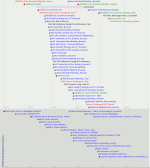
I'm currently doing research on the future of
embedded systems, semiconductor intellectual property cores, and the
ARTEMIS Joint Technology Initiative. Here is a link to a
work-in-progress interactive timeline of the development of ARTEMIS:
16 October 2007 Skills and Learning for the Knowledge Society
-abstract
A short 3-page abstract that summarizes key points
of my presentation at the EU eLearning 2007 Conference panel on
'Re-skilling for the Knowledge Society'. The presentation slides are
available below.
6 November 2007 Mistä
puhumme kun puhumme tiedosta
(What do we talk about, when we talk about
knowledge) Slides from my presentation at Dipoli course on
Information Design. The presentation discussed the historical
evolution of the knowledge society, the emerging business models, and
the meaning-based view on knowledge and information. Most of the text
slides are in Finnish...
16 October 2007 Skills
and Learning for the Knowledge Society
Slides from my presentation at the EU eLearning
2007 Conference, Lisbon.
Does the concept of skills make sense in the world of future? Where did it come from? Do we need a more human-centric model for learning, where competences are socially and socio-technically distributed?
Does the concept of skills make sense in the world of future? Where did it come from? Do we need a more human-centric model for learning, where competences are socially and socio-technically distributed?
11 June 2007 Social Computing and the New Innovation Models
Slides from my presentation at the JRC-IPTS
Exploratory Research workshop on the Socio-Economic Impact of Emerging
Social Computing Applications, Seville.
8 June 2007 Tekijänoikeudet
ja kirjastojen tulevaisuus
(Copyrights and the future of libraries)
Slides from my presentation at the Finnish annual meeting of libraries (Kirjastopäivät), mainly in Finnish.
Slides from my presentation at the Finnish annual meeting of libraries (Kirjastopäivät), mainly in Finnish.
February 2007 Learning in the Age of Networked Intelligence
Abstract: The article presents ten
theoretically substantiated “theses” on future education and learning,
highlighting emerging trends that will shape educational systems. The
focus is on the impact of innovation economy and knowledge society on
learning. Specifically, the article elaborates the changing dynamics
of production models since the first industrial revolution, arguing
that in the last few years we have been in the midst of a
globalization process that is qualitatively different from the earlier
ones. This new model has consequences, for example, for skill demands
and their regional distribution. More fundamentally, this “third
globalisation” makes innovation the key source of economic value,
pushing educational systems from adaptive towards creative learning
models.
In implementing such creative pedagogies, traditional models of innovation become inadequate. The paper therefore describes recent developments in innovation research, and outlines a new theoretical view on innovation, which connects innovation with social change and learning. This “downstream” innovation model highlights the active and creative role of user communities in making innovations real. As the economic and social importance of “downstream” innovation is becoming increasingly visible, educational institutions and learning activity will change. Policymakers will have to answer the question: Why do we need education in the future?
In implementing such creative pedagogies, traditional models of innovation become inadequate. The paper therefore describes recent developments in innovation research, and outlines a new theoretical view on innovation, which connects innovation with social change and learning. This “downstream” innovation model highlights the active and creative role of user communities in making innovations real. As the economic and social importance of “downstream” innovation is becoming increasingly visible, educational institutions and learning activity will change. Policymakers will have to answer the question: Why do we need education in the future?
Working draft, the final version appeared in European Journal of Education, 42(2) pp.235-254, June 2007
30 January 2007 Networks
of Innovation
Presentation slides from my keynote at SummIT'07,
Odense, Denmark. There will also be some video material available from
the
conference web site later. The conference was organized by the
Knowledge Lab. Most of the presentations on the conference site are in
Danish.
15 October 2006 Open Educational Resources: What are they and why do
they matter
A report written for the OECD Centre for
Educational Research and Innovation.
"This report describes ongoing initiatives and underlying concepts in the area of open educational resources (OER). The aim of the report is to elaborate the concept of open educational resources, and provide a practically useful and theoretically solid definition of open educational resources." The link is to the the final draft.
I think the main contribution is on pp. 30-36. Three interrelated concepts need to be defined: one for learning (I use a pedagogic view that combines individual and social development), one for openness (I distinguish three levels), and one for resource (for the OER definition I distinguish traditional goods, common pools, and non-rival fountains of goods). In practice, there are many valid and coherent ways of using the term openness in the OER context. Openness at "level 3" is perhaps most interesting, as it assumes collective contributions.
The final OECD summary report (Giving Knowledge for Free, OECD 2007) skipped my argument about a Mertonian process for defining such collective contributions, probably because its relevance was not very clearly argued. Social evaluation of contributions is necessary, however. This is because, in my view, knowledge exists only as a social phenomenon. "Contribution" can only be distinguished from a "non-contribution" using social quality criteria implemented in a social process. I use the Mertonian approach to put a social theory of knowledge back into the theory of development and learning, without making extra assumptions about the "truthfullness," "empirical validity" etc., of the contributions. Knowledge, therefore, can be local to a specific culture and social practice, historical, and context dependent, but only if it is validated using the internal criteria available in the social practice in question. That’s how Wikipedia, for example, can distinguish spam and forgeries from real contributions.
"This report describes ongoing initiatives and underlying concepts in the area of open educational resources (OER). The aim of the report is to elaborate the concept of open educational resources, and provide a practically useful and theoretically solid definition of open educational resources." The link is to the the final draft.
I think the main contribution is on pp. 30-36. Three interrelated concepts need to be defined: one for learning (I use a pedagogic view that combines individual and social development), one for openness (I distinguish three levels), and one for resource (for the OER definition I distinguish traditional goods, common pools, and non-rival fountains of goods). In practice, there are many valid and coherent ways of using the term openness in the OER context. Openness at "level 3" is perhaps most interesting, as it assumes collective contributions.
The final OECD summary report (Giving Knowledge for Free, OECD 2007) skipped my argument about a Mertonian process for defining such collective contributions, probably because its relevance was not very clearly argued. Social evaluation of contributions is necessary, however. This is because, in my view, knowledge exists only as a social phenomenon. "Contribution" can only be distinguished from a "non-contribution" using social quality criteria implemented in a social process. I use the Mertonian approach to put a social theory of knowledge back into the theory of development and learning, without making extra assumptions about the "truthfullness," "empirical validity" etc., of the contributions. Knowledge, therefore, can be local to a specific culture and social practice, historical, and context dependent, but only if it is validated using the internal criteria available in the social practice in question. That’s how Wikipedia, for example, can distinguish spam and forgeries from real contributions.
12 October 2006 Mistä
puhumme kun puhumme tiedosta
(What do we talk about, when we talk about
knowledge) Slides from my presentation at Dipoli course on
Information Design. Most of the text slides are in Finnish...
10 October 2006 (2 Sep.
05) Meaning Processing as the New Information Society
Paradigm.
This is a paper written for the EU Joint Research
Centre, IPTS, FISTERA project. The full FISTERA (Foresight on
Information Society Technologies in the European Research Area) report
"The
Future of Information Society in Europe" is now available
through the JRC-IPTS site. The full report includes also contributions
from Emilio Fontela, Jeremy Millard, Carlota Pérez, Luc Soete, Erik
Reinert, and John Zysman and Tobias Schulze-Cleven.
10 October 2006 Tietotieteen
vuosikymmen
(The decade(s) of Knowledge Science)
Slides from a keynote at the Finnish annual Knowledge Forum. The
presentation discussed the past 14 years of knowledge management,
tried to summarize what are the new things we have learned, and
described some potential future developments. Most of the content is
in English.
4 October 2006 Social Forces and the Broadcasting Revolution
Slides from my keynote presentation at the annual
meeting of public broadcasters in Belgium (VRT) and the Netherlands,
organized in Mechelen, Belgium.
12 September 2006
Tietoyhteiskunta tilastojen varjossa
(Knowledge society in the shadow of
statistics.) Slides from my presentation at Statistics Finland
discussion group on measuring the Information Society. Some slides in
Finnish...
4 July 2006 Innovations
in Learning: The Present Future of Learning in the Knowledge Society
Slides from a presentation at the EU
eLearning Conference. Ten provocative theses.
30 May 2006 Observations on
the emerging technological landscape and the new media.
Slides from a presentation at the VRT Media
Morgen: Het Congress. The conference was organized to discuss
the future public service contract of VRT, the public broadcasting
company of Flemish-speaking Belgium.
20 May 2006 Recommendations
to cope with Digital Divide
Summary report written for Hitachi Science and
Technology Forum, where I moderated a discussion group on Security,
Safety, and Digital Divide. This will be published in a slightly
shorter version on the Hitachi Science and Technology Forum site in
the near future.
4 April 2006 Tiedon
käsite ja käytäntö (The concept and practice of knowledge)
Slides from a presentation at the Knowledge
Management course at Dipoli, Espoo. Two-thirds in Finnish...
3 February 2006 Meaning
Processing: The Next Wave?
Slides from a presentation at VTT, Espoo, Finland.
14 October 2005 The
Future of Learning in the Knowledge Society: Disruptive Changes for
Europe by 2020 Report for DG JRC - IPTS and DG EAC.
Background paper for an expert workshop on the
future of learning and the impact of ICTs. The final edited report is
now available at http://www.jrc.es
October 2005What did we learn from open source?
First Monday 10(10), Special Issue on Open Source
First Monday asked for a short comment for their
special issue on open source. "What, then, would be the most important
thing we learned, with the most fundamental impact and consequences in
the coming years? Most probably, it is the fact that we need to
redesign intellectual property rights."
6-7 October 2005 The
Great Transformation: Lisbon and Beyond
Keynote at "Lithuanian Knowledge towards Global
Competitiveness: Lisbon Strategy Relaunched." Vilnius, The link is to
the conference program page, where you can find a link to the
presentations.
7-10 Sept 2005 Surfing the Waves of Socio-Economic Development
Slides from my presentation at the XV Economic
Forum. Behind the link, you'll find also the other presentations in
the session. The discussion was about the long-wave interpretation of
economic development, driven by key technologies. The focus was on
Perez's interpretation of the Schumpeterian model and its implications
for the development of the Knowledge Society in the new EU member
states. Krynica, Poland.
16 June 2005Korea and Finland: A Comparative Analysis of Broadband
Diffusion Factors
Slides from my presentation at the FISTERA Final
Conference, Seville, Spain.
June 2005
Broadband in South Korea.
Report prepared for the BREAD "Broadband for All"
coordination action. Describes the history and diffusion of broadband
in South Korea.
11 March 2005Elements
Of Great Transformation
Slides from the kick-off presentation at the
High-Level Group on Foresight on Information Society Technologies in
the European Research Area (FISTERA) workshop. Asks what new can we
say about information society, innovation, globalisation, learning,
work and productivity.
14 December 2004Innovation, Growth and Competitiveness in the
Knowledge Society
Presented at Foro de la Innovación y
Modernización en Andalucía Málaga, 14 December 2004. The paper
complements existing analyses on achieving the Lisbon goals of growth
and competitiveness in Europe, and discusses emerging new approaches.
8 December 2004The
Korean Broadband Miracle
A presentation on the development of broadband in
the Republic of Korea, given in the BroadBand Europe conference, 8
December 2004, Brugge. The conference was organised by the BREAD
Broadband for All coordination action.
Vygotsky
in a TeamRoom: An Exploratory Study on Collective Concept Formation in
Electronic Environments
In the mid-1990s I was developing new methods and
tools for distributed knowledge creation and organizational knowledge
management. One of the ideas was to merge research on communities of
practice and sociocultural theories of learning. My team worked in
this area with several leading researchers, including people who were
designing new collaboration tools at the Lotus Institute (now IBM).
The linked paper was written in 1997. It makes some points that are
relevant for the developers of the semantic net, knowledge ontologies,
and communities of practice.
15 November 2004Productivity,
Globalisation, and Sustainable Growth
Slides from my presentation at the IST'04
Conference panel on sustainable productivity growth, 15 November 2004,
The Hague.
November 2004 The Ethics
of Creation
Appears in November 2004 in Framework,
as an opening essay on innovation, ethics and social space. "Framework
is a discursive forum that opens a space for a variety of visual
material, as well as extensive articles, analyses and international
commentaries."
September 2004The Future
of the European Knowledge Society
This was used as a background discussion paper in
the revision of the eEurope strategy.
28 July 2004Knowledge
Sharing and the Idea of Public Domain
Paper presented at the Unesco 21st Century Dialog
on "Building Knowledge Societies," Seoul, 28 July 2004. A conference
organized in the occasion of the 50th anniversary of the Korean
National Commission for UNESCO and the visit of the Director-General
of UNESCO to the Republic of Korea. Talks about the historical roots
of intellectual property rights and their impact on innovation and
social development. The
presentation slides complement the text by including material on
the social foundations of knowledge, links to social learning
literature, etc.
July 2004
Economic productivity in the Knowledge Society: A critical review of
productivity theory and the impacts of ICT. First Monday, July
2004
The paper examines critically and in some
theoretical and empirical detail the concepts and methods of ICT
productivity studies. It shows why the current analytical techniques
do not allow quantification of the productivity impacts of ICTs, and
discusses the reasons why we may need a new productivity paradigm.
7-8 June 2004Industrial
Structure and Policy Choice: Notes on the Evolution of Semiconductors
and Open Source
Working paper written for "Networks of Knowledge:
Research and Policy for the Knowledge-Based Economy." Workshop
organised by the European Commission, the National Science Foundation,
the OECD and the University of Michigan, Brussels, 7-8 June 2004. The
workshop papers can also be accessed through the DG INFSO High-Level
Socio-Economic Group site.
June 2004 Realising the productivity potential of ICTs
Published in the IPTS Report special issue, June
2004. A concise summary of the main limitations of current methods to
analyze the productivity impact of ICTs, written for a policy-oriented
general audience. Shows that the observed ICT productivity impact has
to a large extent been created by hedonic price indices that have
substantially increased the value and growth rate of computer asset
estimates that are used in productivity calculations.
June 2004Evolution
of the Linux Credits File: Methodological Challenges and Reference
Data for Open Source Research.
"...presents time-series data that can be
extracted from the Linux Credits files and discusses methodological
challenges of automatic extraction of research data from open source
files. The extracted data is used to describe the geographical
expansion of the core Linux developer community." First
Monday, June 2004
The paper also comments a recent Alexis de Tocqueville Institution report that used the working paper version of this article to argue that Linus Torvalds probably was not the inventor of Linux. The Tocqueville report also borrowed my Networks of Innovation, where I studied the history of the World Wide Web, packet switching technology, Linux, etc., and where I pointed out that the conventional inventor model does not work too well for networked and systemic innovations. In fact, contrary to the conclusions made by the Tocqueville authors, I argued that this is one reason why we should rethink the patent system. Historically, it is more accurate to say that Berners-Lee didn't invent the Web (quite accurate) than to argue that Linus didn't create Linux (quite inaccurate). The point, however, is that a careful analysis shows that we need to revise both the concept of inventor and innovation to address software and Internet related innovations.
The paper also comments a recent Alexis de Tocqueville Institution report that used the working paper version of this article to argue that Linus Torvalds probably was not the inventor of Linux. The Tocqueville report also borrowed my Networks of Innovation, where I studied the history of the World Wide Web, packet switching technology, Linux, etc., and where I pointed out that the conventional inventor model does not work too well for networked and systemic innovations. In fact, contrary to the conclusions made by the Tocqueville authors, I argued that this is one reason why we should rethink the patent system. Historically, it is more accurate to say that Berners-Lee didn't invent the Web (quite accurate) than to argue that Linus didn't create Linux (quite inaccurate). The point, however, is that a careful analysis shows that we need to revise both the concept of inventor and innovation to address software and Internet related innovations.
10 May 2004Social Capital: Setting the
Scene
Slides from the presentation at the High Level
Group on the Employment and Social Dimension of the Information
Society (ESDIS), Brussels, 10 May 2004.
February 2004Broadband in Finland
A report on the status of the Finnish broadband,
up to February 2004. This was prepared for the BREAD consortium.
Knowledge
Society and the New Productivity Paradigm: A Critical Review of
Productivity Theory and the Impacts of ICT (Executive Summary)
This is the exec summary of a rather detailed
piece on ICTs and productivity. The full paper (66 pages) is now
available through the DG INFSO Socio-Economic Expert Group site.
4 November 2003ICTs and
Social Capital: Setting the Scene
Slides from my presentation at the IPTS/DG
Employment workshop on ICTs and Social Capital, 4 November 2003.
Data is More than Knowledge
From the editorial: The final paper in the Special
Section, "Data Is More Than Knowledge: Implications of the Reversed
Knowledge Hierarchy for Knowledge Management and Organizational
Memory," by Ilkka Tuomi, is one of the most provocative we have seen
in years. In a very readable and convincing argument, the author
challenges one of the pillars of our discipline ...Perhaps, as Tuomi
asserts, people do first perceive the world as knowledge, then
codify and formalize that knowledge, and then with more effort parse
it into data structures that exactly define its meaning. Only then,
he asserts, can it be manipulated by computers. ...You may agree or
disagree with the author, but either way you will find his paper
highly engaging. We find that it has already broadened the way we
think about issues ranging from systems analysis to Third Normal
Forms. Journal
of Management Information Systems Vol 16 No. 3, pp. 103-118
September 2003 Response to Kurzweil
In Exponential Growth an Illusion?: Response
to Ilkka Tuomi, Ray Kurzweil comments two of my papers that
discuss the development of semiconductor and computing technology.
Kurzweil used his response in his Accelerating Change Conference
plenary keynote 14 September 2003, where we also had a debate on
Kurzweil’s hypothesis. The first paper was my First Monday article on
Moore’s Law and the latter paper was written as a background paper for
the conference (see below). Kurzweil’s comments now give me an
opportunity to clarify some apparently confusing points.
1999As my 1999
book Corporate Knowledge: Theory and Practice of Intelligent
Organizations is about to be out of print, I'll put here
three chapters: Ch 12: Framework
for Knowledge Management, Ch 13: Measurement
in the Intelligent Organization, and Ch 14:
Organizing for Strategic Knowledge Creation. The table of contents
and other related information is at the end of this page.
12-14 September 2003Kurzweil, Moore, and
Accelerating Change
This is a working paper that discusses Ray
Kurzweil's hypothesis of accelerating rate of technical progress in
computing. The paper is based on a set of unpublished papers that
cover Kurzweil's argument more broadly, including the claim that
technological development can be understood as an evolutionary
process. The linked paper focuses on semiconductors and semiconductor
industry, but also makes some comments on generic claims of
technological change. It provides some starting points for my comments
at the Accelerating Change Conference, Stanford, September 12-14,
2003.
3-5 September 2003Beyond User-Centric
Models of Product Creation
Paper presented at the COST 269 Conference: "The
Good, The Bad, and The Irrelevant," Helsinki 3-5 September 2003. It
proposes that we should take social practice as the focus of design of
functional (i.e. technological) products. This requires that we build
social learning models into design processes.
20 February 2003Innovation in the Network
Society
Slides from my presentation at the European
Commission, DG Information Society, Brussels, 20 February 2003. The
presentation focused on the open source innovation model and discussed
the extensibility of this model, as well some potential policy
implications.
28-29 October 2002Human
And Social Capital for a Sustainable Knowledge Society
Slides from my presentation at "Social and Human
Capital in the Knowledge Society: Policy Implications," Brussels 28-29
October 2002. The conference was organized by the Directorate General
Employment and Social Affairs. Related to the theme a couple of
complementary papers: Work,
Technology and Competence: Aspects of the History and the Future of
Work. This was a keynote at the European Conference on Adult
Education and Vocational Training, Tampere 18 November 1999. A more
general overview of issues on organizational learning and knowledge
management is: Learning
And Knowing in Organizations. For a recent overview of the
history and emerging issues of knowledge management, see "The Future
of Knowledge Management," below.
April 2000Learning from Linux: Empirical
and Descriptive Analysis of the Open Source Model
This working paper was distributed in Berkeley and
Stanford in April 2000. It describes organizational, institutional,
economic, cultural, and cognitive aspects of the open source
development model. Its analysis has been extended and updated for
Networks of Innovation (below). I put it on the net for the US-EU
workshop on open source as I mention it in my statement "Open
Source for Human Development".
November, 2002The Lives and Death Of
Moore's Law
Studies the history of Moore's Law and looks for
evidence for its various versions. "Semiconductor technology has
during the last four decades evolved under very special economic
conditions. Contrary to common and widely spread claims, Moore's Law
actually never was valid and it has not been driving developments in
the semiconductor industry or information technology." First
Monday, November, 2002
20 August 2002Development of Information Society in
Finland: Where it came from, where it is going, and what we mean by
"development"
These slides were presented at the kick-off
meeting of the ESTO "Tigers" project, August 20, 2002. The included 36
slides describe some basic historical facts and milestones in the
Finnish information society development, discuss the reasons why Nokia
successfully transformed itself in the 1990s, highlight a couple of
challenges, and propose one approach that could be used to evaluate
information society development.
2002The Future of
Knowledge Management
This came out in Lifelong Learning in Europe
(LLinE), vol VII, issue 2/2002, pp. 69-79.
9 May 2002Innovation and
Development: Strengths and Weaknesses in the Finnish Information
Society
These slides were presented at the South Africa -
Finland bilateral Innovation Policy Seminar, May 9, 2002,
Muldersdrift.
2002/2003Networks of Innovation
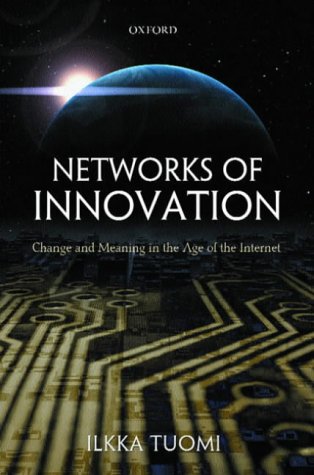
This is an extract of my newest book, containing
the table of contents and the intro in final draft version. The book
came out in November 2002 in Europe and in February 2003 in the US.
I often start reading books from the back, trying to figure out where the author is coming from. Here are the references and the name index for the book.
Oxford University Press asked me to write a short piece on the origins of the book. It is here, unedited. As the book went to print, I received nice endorsements by John Seely Brown, Manuel Castells, Ikujiro Nonaka and Georg von Krogh. I was also happy to see that Peter Denning, one of the key visionaries of computer science and a past president of ACM noted that it is a "wonderful book..." that " does the best job I've seen in revealing the difference between the idea-model of innovation and the way innovation actually works."
The OUP catalog entry is here.
I often start reading books from the back, trying to figure out where the author is coming from. Here are the references and the name index for the book.
Oxford University Press asked me to write a short piece on the origins of the book. It is here, unedited. As the book went to print, I received nice endorsements by John Seely Brown, Manuel Castells, Ikujiro Nonaka and Georg von Krogh. I was also happy to see that Peter Denning, one of the key visionaries of computer science and a past president of ACM noted that it is a "wonderful book..." that " does the best job I've seen in revealing the difference between the idea-model of innovation and the way innovation actually works."
The OUP catalog entry is here.
31
May 2002The
Blog and the Public Sphere
Wonder what the title means? This was a
presentation that I gave at the final seminar of the Academy of
Finland Media Culture research program, May 31, 2002.
June 2002Working in the
Knowledge Society
This was a presentation given at the Helsinki
University of Art and Design, for the joint conference of the Humantec
and IDIA thematic networks. The presentation starts from a macro-level
question: why ICT doesn't seem to appear in economic statistics? It
makes a brief "ethnographic" study of Microsoft images that illustrate
knowledge work, discovering the most important tool for knowledge
work, the social and cognitive coffee cup. I refined some of these
ideas also for a presentation at the UC Berkeley Institute for Design
/ Human-Centric Computing retreat, Lake Tahoe, June 2002.
From
Periphery to Center: Emerging Research Topics on Knowledge Society
A study where I tried to find information society
research topics that today seem peripheral but which could become
central in the next five years. This was done as background work for
the Finland-Berkeley Information Technology and Society research
program. The report is available in paper format from Tekes,
the Finnish Technology Agency. Parts of the report are currently being
translated to German and will appear in 2002.
July 2000Beyond the Digital Divide
An informal and somewhat provocative discussion
paper on Digital Divide. I presented it at the UC Berkeley
Human-Centric Computing retreat, July 2000. The paper seems to be
getting relevant again. It starts with the line: "If we study
available evidence, the digital divide is closing rapidly." The main
point is that we need to move beyond a simplistic technology-focused
view on DD. Instead, we need to address access to meaningful social
interaction, access to economically useful resources, and access to
individual development. I'm currently planning to write a revised
version of this paper where I try to show how, exactly, technology is
relevant. Indeed, it has a lot of relevance, but this has little to do
with access to PCs or the net. More on that later...
Neural
networks as measurement type computers: Some theoretical reasons for
non-algorithmic information processing
Inspired by Stephen Wolfram's recent book (see
Levy: The
Man Who Cracked the Code to Everything) I dug into the depths of
my hard disk and recovered an old paper, from 1988. It shows why
Wolfram's project can never succeed. The paper argues that only few
special types of problems can be solved by algorithmic computer
programs and that most natural phenomena fall beyond this class of
problems. The paper also describes the starting problem of Turing
machines which makes it, in general, impossible to start the
computation if the result of the computation needs to have some useful
accuracy. The problem with the Wolfram universe, therefore, is not
only how to program it, but also how to describe the data it is
supposed to operate on. A few comments on Wolfram and the history of
the paper are available here.
1999 My previous
book was Corporate Knowledge: Theory and Practice of Intelligent
Organizations, Metaxis, 1999. 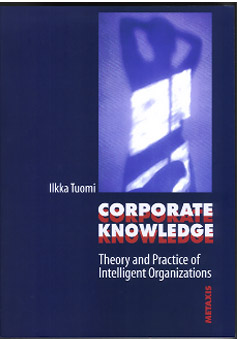
Abstract, TOC, and Intro are available here. There is also a wikipedia entry, written by someone who seems to understand what he/she is writing about.
Some people ask how to get hold of the book. I was planning to rewrite it for an international publisher, so the distribution was only through the Academic Bookstore, Helsinki. The book is now out of print but available through some libraries (ISBN 951-98280-0-1; 453 pages)
Abstract, TOC, and Intro are available here. There is also a wikipedia entry, written by someone who seems to understand what he/she is writing about.
Some people ask how to get hold of the book. I was planning to rewrite it for an international publisher, so the distribution was only through the Academic Bookstore, Helsinki. The book is now out of print but available through some libraries (ISBN 951-98280-0-1; 453 pages)
last updated: February 2020
(and written in HTML, for fun... Ain't it retro...)